The Role of Landing Headers in Modern Smart TV Web Design
When designing a webpage to showcase a Smart TV product or service, the initial visual impression is crucial. The Smart TV Television Landing Header is a specialized web design element engineered to create this first critical point of engagement. It’s not merely a decorative banner; it's a functional component located at the very top of a landing page, designed to immediately communicate core value propositions and guide user attention.
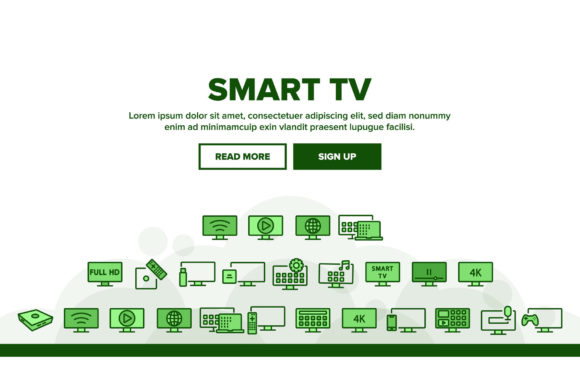
What makes a Smart TV Television Landing Header distinct from a generic header is its intrinsic focus on technology and media consumption. It integrates visual motifs like Full HD and 4K resolution indicators, representations of gaming and video streaming, and often abstract illustrations of connectivity or energy efficiency. This immediate visual coding helps a visitor understand the page’s context within seconds, setting the stage for deeper exploration of features, specifications, and offers.
Understanding the Components and Design Intent
A well-executed Smart TV Television Landing Header operates on multiple levels. First, it serves as a high-impact visual summary. By incorporating vector illustrations of devices, on-screen content, or sleek interfaces, it bypasses lengthy textual explanations. For a visitor researching Smart TVs, seeing a header that visually articulates “4K gaming” or “streaming integration” is more immediate than reading a paragraph about it.
Second, it acts as a navigational anchor. Often, these headers contain minimal, strategic calls-to-action, such as “Explore Models” or “Compare Features,” placed within the visual context. The design template itself—available in formats like JPG for direct use, or AI, PSD, and EPS for customization—is built for this dual purpose. Using an editable vector format (AI or EPS) allows designers to tailor the imagery to match the exact Smart TV brand’s aesthetics, perhaps emphasizing gaming prowess for one audience or cinematic picture quality for another.
The practical strength of starting with a professional template lies in efficiency and coherence. For a business creating a comparison hub for various Smart TVs, a consistent header design across different product pages fosters a trustworthy, organized user experience. It signals that the information presented beneath is part of a structured evaluation resource.
Tradeoffs Between Customization and Template Use
Choosing to implement a Smart TV Television Landing Header from a pre-made template involves considering several tradeoffs. The primary benefit is speed and a guaranteed baseline of professional design quality. Templates, especially those provided in layered PSD or AI files, offer a quick start. They handle the complex composition of technology illustrations, device mockups, and text hierarchy.
However, the limitation is potential genericness. A template might use a standard illustration of a gaming controller or a 4K badge. For a site reviewing extremely niche products—like Smart TVs specialized for home theater purists or for low-latency competitive gaming—the template imagery might not feel specific enough. In such cases, the editable vector formats are essential. They allow a designer to replace generic icons with more precise imagery or to adjust the color scheme and layout to better reflect a particular brand’s identity or a specific technical focus.
Another consideration is format selection. Using a JPG or PNG provides a fast, fixed solution, but resizing or altering components is difficult. Opting for the EPS or AI source files grants full flexibility but requires design software and expertise. The best-fit situation for a template is often a project needing a high-quality starting point that can be moderately customized to align with the site's overall tone without requiring original illustration from scratch.
Comparing the Landing Header to Other Page Introduction Methods
It's useful to compare the Smart TV Television Landing Header with alternative approaches for introducing a product page. Some sites opt for a minimalist header: a simple product name and a stark, high-resolution photograph of the TV itself. This approach leans heavily on the product's physical aesthetics and can be powerful for visually stunning devices.
The Smart TV Television Landing Header typically offers more contextual information. While a photograph shows the device, a well-designed header illustration can show the device in use—streaming a popular service, displaying a vivid game scene, or connected to multiple peripherals. This conveys functionality and lifestyle integration, which can be more compelling for users evaluating how the technology fits into their daily routines.
Another common alternative is a video-based header or a dynamic carousel. These can be engaging but come with performance tradeoffs. They may increase page load time, potentially frustrating users seeking quick information for comparison. A static, optimized vector-based Smart TV Television Landing Header balances visual richness with reliable, fast loading—a significant factor for users researching on mobile devices or with limited bandwidth.
The decision here hinges on the primary user intent. For a page aimed at technical comparison and feature evaluation, a header that immediately visualizes key attributes (like HDR support or refresh rates) may be more helpful than a slow-loading video. For a brand-focused storytelling page, a cinematic video might be preferable.
When is a Smart TV Television Landing Header the Right Choice?
This design element is particularly effective in specific scenarios. It is an excellent fit for aggregate sites or “hub” pages where multiple products or models are listed. For example, a website comparing the latest 2024 Smart TVs from various manufacturers can use a unified header to establish the page’s theme—“Ultimate Smart TV Comparison”—while imagery hints at the criteria being compared (picture quality, smart features, gaming).
It’s also a strong choice for service-based pages. Consider a site promoting a streaming platform optimized for Smart TVs. A landing header depicting a Smart TV screen seamlessly running that platform’s interface, with clear 4K and HDR labels, instantly communicates compatibility and performance benefit. The header sets the context before the text delves into setup guides or subscription details.
Furthermore, for technical audiences, such as those researching home theater setups, a header that highlights specific technology standards (like Dolby Vision illustration or HDMI 2.1 ports) can signal that the following content will address detailed, high-end considerations. It acts as a filter, assuring knowledgeable visitors that the page matches their level of interest.
When Might Another Option Be More Suitable?
Despite its utility, a Smart TV Television Landing Header isn’t universally optimal. In cases where the product’s physical design is its paramount selling point—a luxury TV with a unique, artisan finish—a high-resolution, full-screen photograph of the product itself may be more impactful. The header template’s illustrative style could distract from the tangible beauty the brand wants to showcase.
Similarly, for pages with an extremely narrow, technical focus—like a deep-dive into a single TV’s calibration settings—a simpler, text-focused title might be preferable. The goal here is to minimize visual distraction and get the user straight into the dense technical content. Adding an illustrative header could feel superfluous.
Also, if brand guidelines are extremely rigid, a pre-made template might not align perfectly. While vector formats allow editing, completely reshaping a complex illustration to match a brand’s exact visual language can be as labor-intensive as creating an original. In such tightly controlled environments, starting from a brand’s own design assets might be the mandated path.
Decision Factors for Implementers
If you are tasked with choosing or implementing a header for a Smart TV-related page, consider these practical factors:
- Audience Intent: Are visitors coming to quickly compare specs, or to be inspired by the lifestyle the product enables? A comparative, info-seeking audience often benefits from the immediate context a good Smart TV Television Landing Header provides.
- Page Performance: Will the page be accessed on various devices and connection speeds? Optimized vector graphics (in SVG or compressed PNG formats derived from the AI/EPS source) typically offer better performance than video or overly complex imagery.
- Content Scalability: Will the same header structure be used across multiple pages or product lines? A template-based Smart TV Television Landing Header ensures visual consistency, making a comparison site feel more organized and trustworthy.
- Customization Need: Does the imagery need to reflect a very specific feature or a proprietary brand element? Assess the editable capabilities of the PSD, AI, or EPS files against your specific needs.
Ultimately, the choice revolves around communication efficiency. A Smart TV Television Landing Header is a tool for fast, visual storytelling. It condenses the complex value propositions of modern television technology—connectivity, resolution, gaming, streaming—into an at-a-glance graphic. When aligned with the user's search intent and the page’s deeper content, it becomes more than just a pretty top bar; it becomes a functional guidepost, steering the research and evaluation process in a clear, helpful direction from the very first moment.